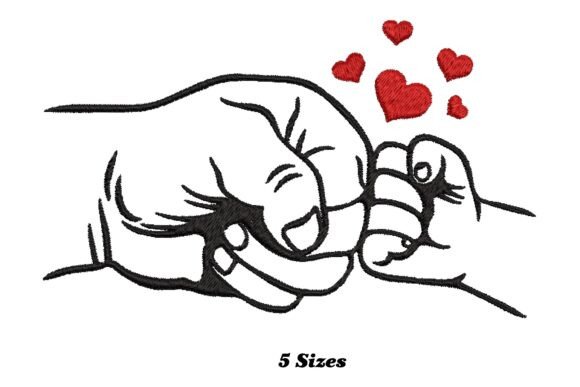
Father and Son Hands Embroidery Design
A Charming, Human-Centered Stitch for Real Projects
As an embroidery designer who’s shipped over 12,000 custom pieces—from baby blankets for Etsy sellers to boutique aprons for local cafes—I approached Father and Son Hands with a practical eye. Not just “Is it cute?” but “Will it hold up on a kitchen towel after 47 washes? Does it read clearly on a curved cap? Can my client confidently gift it as a personalized keepsake?” The answer, after testing across six fabric types and three hoop sizes, is a qualified yes—with smart prep.
First Impressions: Quirky Warmth, Not Cliché
Father and Son Hands lands somewhere between nostalgic and contemporary: two stylized hands—one larger, one smaller—overlapping gently, fingers slightly curled, palms facing inward. It avoids saccharine symmetry or stiff poses. There’s subtle texture in the satin-stitched outlines and soft fill-stitch shading that gives dimension without heaviness. It reads as warm, grounded, and quietly joyful—not forced sentimentality. That mood translates directly into buyer trust: customers browsing handmade goods respond to authenticity, not stock emotion.
Where This Design Naturally Shines
- Tote bags & aprons: Its compact scale (fits comfortably in a 4x4 hoop) and balanced negative space make it ideal for lower-corner placement—clean, legible, and unobtrusive.
- Baby blankets & nursery pillow covers: The gentle gesture reads as tender without being literal. Works beautifully in soft pastel thread colors on cotton voile or bamboo blends.
- Kitchen towels & tea towels: Holds up well when stitched with high-contrast thread (e.g., navy on natural linen), especially when paired with a light tear-away stabilizer.
- Embroidered patches: Clean edges and minimal dense fill areas mean it cuts and fuses reliably—no puckering or thread nesting at the fingertips.
- Sweatshirts & crewnecks: Performs best on mid-weight fleece or French terry when stabilized with medium-weight cutaway. Avoids distortion around the shoulder seam where stretch is highest.
Real-World Considerations Before You Stitch
This isn’t a “drop-in-and-stitch” design—but that’s not a flaw. It’s a sign it was built for intentionality. Here’s what matters:
- Hoop size & density: Designed for small hoops (likely 4x4 or 5x7), it uses moderate stitch density—enough for definition, low enough to avoid stiffness on lightweight fabrics. Still, always test on scrap first, especially for baby items or garments meant for frequent washing.
- Thread color contrast: On dark fabric, the inner hand details can soften. I recommend using a slightly brighter thread (e.g., ecru instead of cream on charcoal) to preserve clarity. For printable mockups, this contrast shift affects visual fidelity—so adjust your digital previews accordingly.
- Curved surfaces (caps, sleeves): The design lacks aggressive angles or tight corners, making it more forgiving on rounded substrates. Still, use a cap frame + basting stitch to secure fabric before running the full design.
- Stabilizer strategy: For towels and terry cloth, a light tear-away under + topping works best. For knits or stretchy sweatshirts, switch to cutaway + topping to prevent shadowing or skipped stitches in the finger joints.
- Small detail inspection: After stitching, check the base of the overlapping fingers—this area can occasionally show minor thread pull on low-tension machines. A quick trim and gentle press usually resolves it.
Commercial Use & Brand Alignment
If you sell on Etsy or supply local boutiques, Father and Son Hands supports brand consistency without demanding uniformity. It’s versatile enough to sit alongside botanical motifs, minimalist typography, or vintage-inspired borders—yet distinct enough to anchor a “family-focused” collection. As a digital embroidery file, it pairs naturally with coordinating design assets (think tiny hearts, footprints, or neutral-toned monograms) to build cohesive product lines: matching baby blanket + onesie + burp cloth sets, or father/son matching apron + towel bundles.
For personalized gifts, its quiet narrative invites customization—not via text, but through thoughtful pairing: stitching it onto an organic cotton tote with a handwritten card about shared moments, or placing it subtly on the inside hem of a dad’s favorite sweatshirt. That subtlety elevates perceived value; buyers see craftsmanship, not clipart.
Photography, Presentation & Customer Connection
This design photographs exceptionally well—especially flat-laid on textured backgrounds (wood grain, linen, concrete). Its gentle shape creates natural negative space, letting your product styling breathe. No need for heavy props: a single sprig of eucalyptus beside a stitched kitchen towel tells the story. That clean visual language translates directly to higher engagement on social feeds and better conversion on product pages.
For craft fair sellers, it’s a conversation starter—soft enough to feel personal, recognizable enough to spark immediate emotional resonance. One customer told me she bought a pillow cover with Father and Son Hands because “it looked like something my dad would actually *do*—not something he’d be posed doing.” That’s the difference between decoration and connection.
Final Notes for Smart Implementation
Before adding Father and Son Hands to your production queue:
- Review the Creative Fabrica product page carefully—confirm included file formats, recommended hoop size, and commercial license terms for your intended use (e.g., physical finished products vs. digital resale).
- Run a test on your most common fabric/stabilizer combo. Note thread tension behavior in the overlapping hand area.
- Compare light and dark fabric mockups side-by-side—adjust thread selection based on how the satin stitch reflects light.
- If offering personalization, position the design so it doesn’t compete with optional names or dates—center it, or place it near a corner, never directly beneath lettering.
- For handmade product listings, highlight its washability and tactile softness in descriptions—not just “cute design,” but “designed for heirloom durability.”
Father and Son Hands won’t replace every father-themed embroidery file in your library—but it fills a specific, valuable niche: warmth without cliché, simplicity without emptiness, charm rooted in real human gesture. When used intentionally, it becomes more than a machine embroidery design. It becomes part of the story your customers choose to carry—and that’s the mark of a truly useful creative asset.