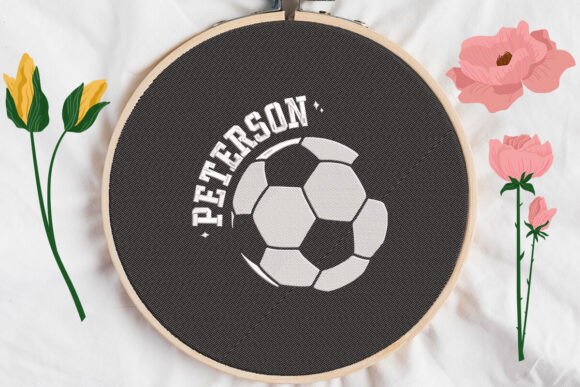
Peterson Soccer Embroidery Design
A Practical Review for Small Business Merch & Branded Patches
As an embroidery designer who’s developed hundreds of commercial embroidery files for boutiques, cafés, pet brands, florists, and handmade studios, I approached Peterson Soccer with a very specific question: *Can this machine embroidery design strengthen a small business’s brand—not just decorate it?* The answer isn’t just “yes” or “no.” It depends on how you use it, where you place it, and what kind of visual story your business tells. Let’s break it down.
First Impression: Friendly, Sporty, and Approachable
Right away, Peterson Soccer reads as warm and inclusive—not aggressive like a pro team logo, nor overly technical like a tournament badge. It carries the energy of community soccer: local leagues, youth teams, weekend pickup games. That makes it unexpectedly versatile for non-sports businesses too. A bakery named “Peterson’s Loaf & Kick” could use it subtly on aprons. A florist launching a “Soccer Mom Bloom Box” gift set might embroider it on linen tote bags. Its charm lies in its balance—playful enough for Etsy sellers, clean enough for retail merch, and distinct enough to avoid blending into generic sports clipart.
Where Peterson Soccer Shines in Real Business Use
- Embroidered patches: Ideal for iron-on or sew-on application on jackets, backpacks, or denim aprons—especially when paired with a simple border or monochrome thread palette.
- Staff uniforms & apron embroidery: Works beautifully at 2.5"–3.5" width on chest or sleeve placement. The balanced proportions hold up across cotton twill, canvas, and medium-weight poly-blends.
- Cap embroidery: At front-center (2.75" wide), it reads clearly without crowding the curve—provided letter spacing and shape clearance are confirmed in your embroidery software.
- Tote bag design & product packaging accents: Scales well to 4"–5" for canvas totes or woven labels on handmade soap or candle boxes—adding authenticity without shouting.
- Customer gifts & event merch: Perfect for limited-run embroidered keychains, mini towels, or co-branded swag with local leagues or schools—building goodwill while reinforcing brand identity.
- Etsy branding & craft business assets: As a digital embroidery file, it integrates seamlessly into printable mockups for listings—giving handmade product photos instant credibility and cohesion.
Use With Care: Critical Considerations for Commercial Embroidery
Not every surface or size suits Peterson Soccer. Here’s where attention matters:
- Small patch sizes (under 1.75"): Fine details—like thin stems, tight curves, or subtle shading—may collapse or blur. Always test stitch-out at your target size before bulk production.
- Cap fronts & curved surfaces: While generally cap-friendly, verify that the lowest elements don’t dip below the curve’s natural fold line—stitch distortion can mute legibility.
- Textured fabric & dark uniforms: High stitch density (if present) may sink into terry cloth, fleece, or heavy twill. Pair with cutaway stabilizer and consider simplifying thread colors for contrast—e.g., white or kelly green on navy.
- Frequent washing: If used on staff aprons or reusable totes, confirm thread colorfastness and recommend gentle cycles—especially if metallic or specialty threads are part of the original embroidery file.
How Peterson Soccer Builds Brand Identity—Beyond Decoration
This isn’t just a sports-themed graphic—it’s a quiet trust signal. When customers see Peterson Soccer thoughtfully placed on a café’s barista apron or a pet brand’s bandana, it implies intentionality: *This business cares about craft, consistency, and connection.* That perception lifts perceived value. Unlike generic vector logos, an embroidered version signals handmade care—even when produced digitally. It also supports visual consistency across touchpoints: same design on a tote, a cap, and a thank-you card tag creates rhythm and recognition. For Etsy sellers especially, that cohesion helps buyers remember your shop between scrolls—and return for more custom apparel or branded patches.
Essential Embroidery Designer Notes Before You Stitch
- Test the machine embroidery design in black-and-white first—this reveals hidden density issues, overlapping stitches, or unclear outlines that color masks.
- Check minimum viable size: Does Peterson Soccer remain legible at your smallest intended patch size? Resize in your embroidery software and simulate stitch count.
- Review thread color contrast against your base fabric—especially for small business merch where lighting varies (e.g., boutique shelves vs. outdoor markets).
- Inspect spacing between letters and graphic elements—tight kerning may cause thread nesting on low-density fabrics.
- Confirm hoop size compatibility. If your shop uses standard 4x4 hoops, ensure the design fits—or plan for re-hooping steps that impact turnaround time.
- Always test on real fabric with your intended stabilizer. Fabric texture changes everything—what looks crisp on polyester may fuzz on organic cotton.
- Create a printable mockup for client approval *before* stitching. A photo-realistic preview prevents costly revisions and builds confidence in your commercial embroidery process.
- Compare Peterson Soccer beside your other design assets—does it harmonize with your existing logo, fonts, and brand palette?
- Verify commercial licensing. Since this is a digital embroidery file, confirm whether it permits resale on physical goods, unlimited runs, or third-party fulfillment—critical for small business merch and wholesale partners.
Remember: Peterson Soccer doesn’t need to be the hero of your brand—it can be the thoughtful accent that ties your story together. Whether stitched on a baker’s flour-dusted apron or a florist’s reusable tote, it brings warmth, movement, and human-scale energy to everyday products. Used intentionally, it becomes less about soccer—and more about showing up, consistently and authentically, for your customers.